
We are witnessing a moment that will define the legal and constitutional landscape of our state for generations. With the identification of Cole Tomas Allen following the events at the Washington Hilton, the nation is asking: Do the new federal protocols apply here? Just 48 hours ago, on April 24, 2026, the Department of Justice officially rescinded the federal execution moratorium. By authorizing firing squads and nitrogen gas to "expedite the ultimate punishment," the federal government has signaled a pivot toward speed over scrutiny. While charges against Allen currently focus on firearms and assault, the growing shadow of 18 U.S.C. § 1751 suggests a federal push for maximum accountability—and maximum velocity.
The Cincinnati Connection: The Ghost of Derrick Jamison
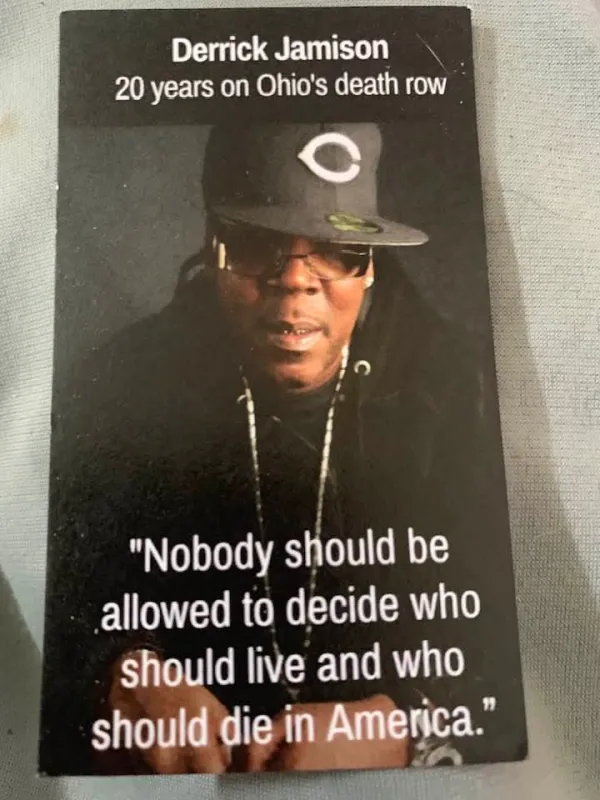
If the administration intends to use cases like Allen’s as a benchmark for efficiency, we must first look at the face of Derrick Jamison of Cincinnati. Derrick is a good friend of mine and a former committee member of Protecting Ohioans’ Constitutional Rights. His story is not just a case study; it is a living testament to the flaws in our machinery of justice.
Derrick spent 20 years on death row for a crime he did not commit. He was scheduled to die six different times. If the system had been "streamlined" in the 1980s—if the clock had been shortened to satisfy a political mandate for "speedy justice"—Derrick Jamison would have been executed long before the truth surfaced.
It took two decades to uncover 35 pieces of evidence withheld by the prosecution—evidence that pointed to his innocence. Under the new federal blueprint, that window of discovery is being slammed shut. When we value a quick result over a correct one, we ensure that the next Derrick Jamison will not survive to tell his story.
A Broken Record of Injustice: Ohio’s Wrongful Conviction Crisis
We have stood before the Ohio General Assembly multiple times to testify for the abolition of the death penalty, bringing the cold, hard facts to the halls of power. The reality is staggering: Ohio consistently ranks in the top 10 states for wrongful convictions. Since Ohio reinstated capital punishment in 1981, the state has executed 56 people but exonerated 12 others from death row. That is a failure rate of one exoneration for every five executions. This isn't just a statistic; it is a systemic indictment. When we rush the process, we aren't just accelerating justice—we are accelerating the potential for state-sanctioned murder of the innocent.
The Ohio Blueprint and the Political Horizon
The federal government is now providing the "legal cover" Ohio lawmakers have sought to advance HB 36. By authorizing alternative methods like nitrogen gas, they are effectively removing the "drug shortage" hurdle that has kept Ohio executions at a standstill under Governor Mike DeWine. However, a leadership shift is on the horizon. While Governor DeWine has issued a fresh round of reprieves as recently as April 17, 2026, his term is nearing its end. If Vivek Ramaswamy or a similar "MAGA" platform candidate secures the governorship, the synergy between a federal "fast-track" and a state supermajority will likely end the current hold on executions. The push to expedite the death penalty will become a legislative priority, leaving little room for the lengthy appeals that often catch wrongful convictions.
A Call to Action: The Power of the People
As independent media and citizen journalists, we are the final shield against a system that prioritizes finality over fairness. We see the truth documented in real-time—from digital footprints to the circulating photos of Allen’s Israeli army T-shirt—proving that the "Fourth Estate" is more vital than ever. To protect the innocent, we must demand two things: End the Immunity: We must stop protecting officials who hide evidence for decades.
Strengthen Open Courts: We must ensure the truth has its day before an irreversible sentence is carried out. For those who have fought for 30 years to end capital punishment, the path forward is clear. We cannot wait for the legislature to act. We must urge a Citizen-Led Ballot Initiative to let the people of Ohio decide the future of our constitutional rights. The truth is no longer just televised; it is being documented by us, in real-time. The Fourth Estate is rising.
-------
Miss Cynthia Brown is the Founder of the Heartbeat Movement Inc., Chair of Protecting Ohioans’ Constitutional Rights, Founder of the Ohio Coalition for Police Accountability and Transparency (OCEQI).